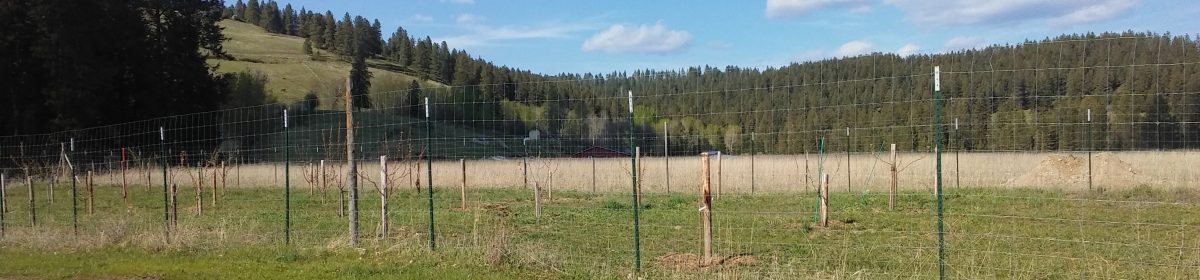
Spring has finally arrived here in NE Washington, and the last tree of the season has just been tucked into the earth. There’s something magical about walking through the orchard this time of year, looking for those first signs of life, taking in the shape and health of the tree, imagining all the fruit it will yield in its lifetime.
After moving 10+ times in the last 20 years, and planting 2 orchards before, we are thrilled to watch this one mature! It was planted the spring after Gail was born, so it’s her twin – they’re both 3 this year. They are beginning to look like real trees – their baby bark is splitting, their grafts healing over, their arbor taking shape. What a marvel!

Sadly, winter’s aftermath taught another costly lesson. Last year, we discovered that a few of the tree varieties we’d planted could not tolerate our faux thaws that plague these parts. A couple apricots died back to their root stock, and a prune tree too. One apple tree just didn’t “take”. This year, we suffered a terrible rodent assault. During the tranquil, snow-blanketed months, little thought was given to our young trees, awaiting Spring’s sweet kiss to wake them. But under that blanket of snow a terrible evil lurked. When winter released its grip on the orchard, how gut wrenching to find that mice or voles had completely girdled FIVE of the most beautiful peaches and nectarines! They nearly completely girdled 13 more trees!!! What carnage!

When a tree is “girdled”, their outer cambium layer of bark is eaten around the entire circumference of the tree. This outer layer of bark is what transports food from the leaves to the roots – it is the circulation system of the plant. So, while my trees upper trunks, and scaffolding looked promising and lovely, ready to bud, it was doomed to die. Who knew the 5 stages of grief apply to trees? At first I was in denial, hoping that they might make it, recover by some miracle. Next came anger. The beagles were called to route the enemy. (Little good that did – they preferred the pit where dead things are chucked over the winter!) Bargaining followed – perhaps, if I bridge grafted the trees, they would live? Perhaps, despite my sons impressive cat allergy, I could round up an army of foxy cats to eradicate the rodents? Maybe, if I dug them up, and buried them really deep, like a too-tall tomato, they would recover? Once that lunacy cleared, depression came. After all, we’ll probably just move again, so who really cares whether my trees live or die. Then, reality sunk in and sadness overtook me. My poor bewildered husband didn’t know what to do when I broke into tears lamenting the loss of my trees. You don’t just loose the initial cost of the trees – you loose years! And they were dead for good! In his practical, sensible way, he asked, “So what are you going to do about it?”
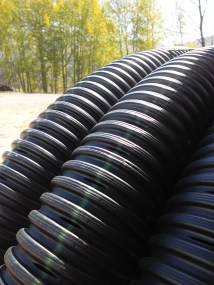
Well. That was a good question. After much Googling, we purchased 100′ of flexible corrugated 4″ drain pipe, which we plan to cut into 2′ lengths and slit up the side to create a protective “sleeve” that will extend the full depth of the snow over the winter. (We will wait until late Fall to do this, so the trunk is visible over the Summer and Fall) The only advantage to the devastation of young trees was that I got to go out and buy more trees – a splendid pastime!
If you have ever lived in snow country, then you understand the excitement of getting your seed and nursery catalogues in February when the snow is deep and the chill severe. A little stash of catalogues had been perused by everyone in the family, pages dog-eared, notes scribbled in the margins, and here was a chance to actually order something! After much cost comparison, zone checking, and shipping calculation, we ended up driving to our favorite local nursery: the one who actually gets trees grown in and for our area. I would like to share with you the thought processes that went into the planning of our orchard, and the replacement of those poor dead trees.
Here are the 7 “P’s” of planting trees:
PLAN
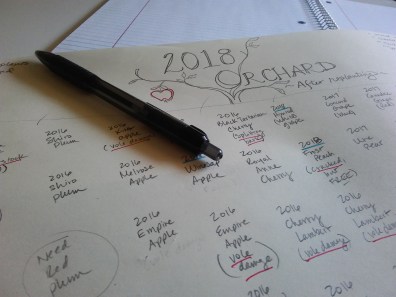
Know your zone! Know what you want! Know where you’re going to put your tree! In zone 5B, our trees have to be very cold hardy.
Know what you want. When planting a stone fruit (peach, plum, nectarine), I always want it freestone, because I detest cutting around pits. Consider your purpose: fresh eating, drying, canning, winter storage etc.
Know what you need. You might be low on early bearing fruit, or late season fruit. You may need a pollinator for certain varieties of trees that are not self-fruitful, so arm yourself with knowledge at the outset.
PREPARE
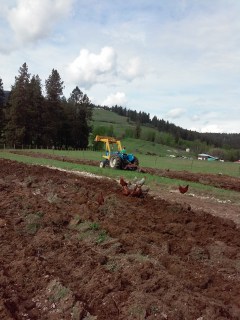
You do yourself and your tree a grave disservice by buying a tree, or shrub, and not having a site ready to receive it. I’ve stunted more than one plant/tree through enthusiastic purchasing and inadequate preparation, and my plants withered in the pot. Know where it is going. Remove rocks and sod from the soil. Have any amendments you need at the ready. Gather all your tools and materials. If you’re planting on an exposed, windy site, have stakes to support your tender saplings. If gophers and mice are a problem, get the appropriate wire to create cages. Whatever you do, do not skimp on this step – it will haunt you if you do!
PURCHASE
Find a reliable source for your trees. Thankfully we have a wonderful local nursery with very knowledgeable staff. They also make a point of only providing trees that will flourish in our area, and don’t truck in trees from the warmer south so all the trees have bloomed and then freeze once they get here. Trees are not cheap, but when you consider the years of costly produce they will provide they are by far the best investment you can make on the homestead. A semi-dwarf apple tree will produce 250-400 pounds per harvest, with an average lifespan of 20-30 years. Inspect the trees for healthy branches, a straight, strong trunk, ensure there are no scratches or broken limbs, the bark is free from disease or damage. Our nursery goes the extra mile and wraps the generous pot in a plastic liner, and gently binds the branches with twine so the trees can be safely transported home. Plus, their prices beat the box farm store, and their plants, knowledge, and competence far exceed them.
PLANT
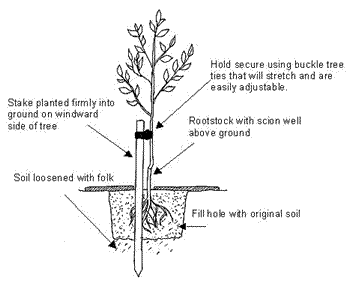
Now that you’ve brought your trees home – get them in the ground! Dig a generous hole, 2-3 times the size of your pot or root ball. Add some nice compost to your dirt. If you’re placing an underground wire, now is the time to do it. Position your tree in the hole. Inspect the roots for damage or binding, and spread them gently on a mound of packed soil. Orient the graft to the north to prevent sunburn, and be sure it is not buried. We lay a shovel across the hole to see where ground level is to make sure the tree is buried neither too high nor too low. Backfill, and create a berm around your tree to catch and hold water. Mulch up to the tree, but prevent the mulch from touching the bark. Mulch may be bark, straw, or even cardboard – it helps retain moisture and prevent weeds. Water well to settle the tree in place. Allow the tree to dry out between waterings, it is possible to “drown” a tree. However, newly planted trees must be kept moist as their root systems are just developing. You may need to stake a tree if it is slender, or exposed to winds.
PROTECT
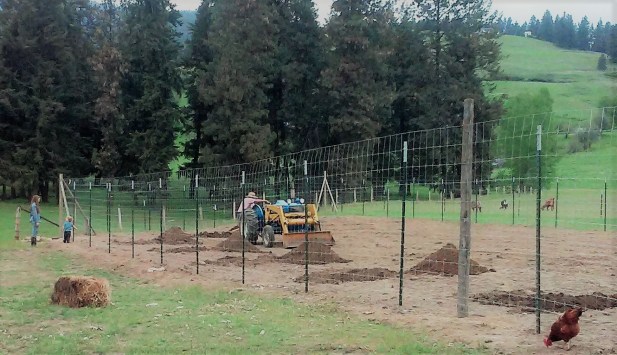
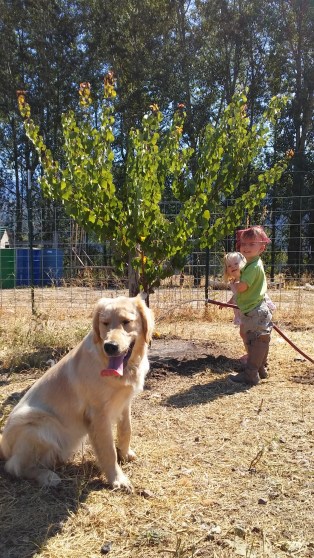 We live in deer country (a.k.a. oversized voracious rodents!!!), and nothing can be planted in peace without proper protection. Here, that means 7′ fencing ($$$)! If you’re only planting a few trees, you may fence the trees individually, rather than a large area – we did this for our nut trees down in the pasture. Sufficient watering is the best defense against disease and frost damage. As we’ve learned, one must also protect against actual rodents by placing tree tape, or pipe sleeves around delicate trunks over winter. Some people “fence” underground around their tree’s rootball with chicken wire. A gopher climbed into my mother’s hardware fortified garden boxes and make itself a cozy little home as it took a bite out of each of her zucchini, so I’m not a believer in underground wire. But, you’re welcome to try it and prove me wrong! You really must take protection seriously, because even one night with a gate open to the orchard, or the fence unbuilt, or one winter without sleeves, can result in serious damage, even death to your trees.
PICK & PRESERVE!
Someday, we will get the pleasure of practicing this part of keeping an orchard. Our property came with an old neglected apple tree, a blighty pear tree, and a lichen-covered plum tree. After much thoughtful and drastic pruning, they are now bearing fruit prolifically. While waiting for our trees to grow, we joined a local Gleaners Club, and that was a terrific educational and fruitful experience. It helped us learn the seasons of the fruits, and gave us opportunity to practice preserving them. We’ve dried Italian Prunes, canned hundreds of pounds of peaches and pears, made plum and cherry jam, dried fruit leather – the possibilities are numerous and oh-so-good! We look forward to one day harvesting the fruit from our very own orchard with our children and grandchildren.


Our hope in keeping an orchard is that the Lord blesses the trees, and the labor of our hands so that we can feed our family from the land He’s given us, and afford to be generous to friends, family, and those in need. We know that only He can give the harvest(1 Corinthians 3:6-7)! Caring for the trees illuminates so many passages of Scripture: we know better the Husbandman, the Parable of the Fig Tree, the Blessings of Righteousness, the Work of Patience, and how we are Known by our Fruits. Treekeeping gives you an eye for the future, a love for things that last, and above all awe and love for our Savior Jesus Christ whose Tree gave life eternal! Praise God from Whom all blessings flow!
Happy Tree Planting!
~ Mother
 Rosehaven Homestead